Core concepts
AI vs ML: what is the difference?
Artificial intelligence is the broad goal of building systems that can reason, learn, act, and adapt. Machine learning is one way to achieve that goal by training models to learn patterns from data. They are connected, but they are not the same thing.
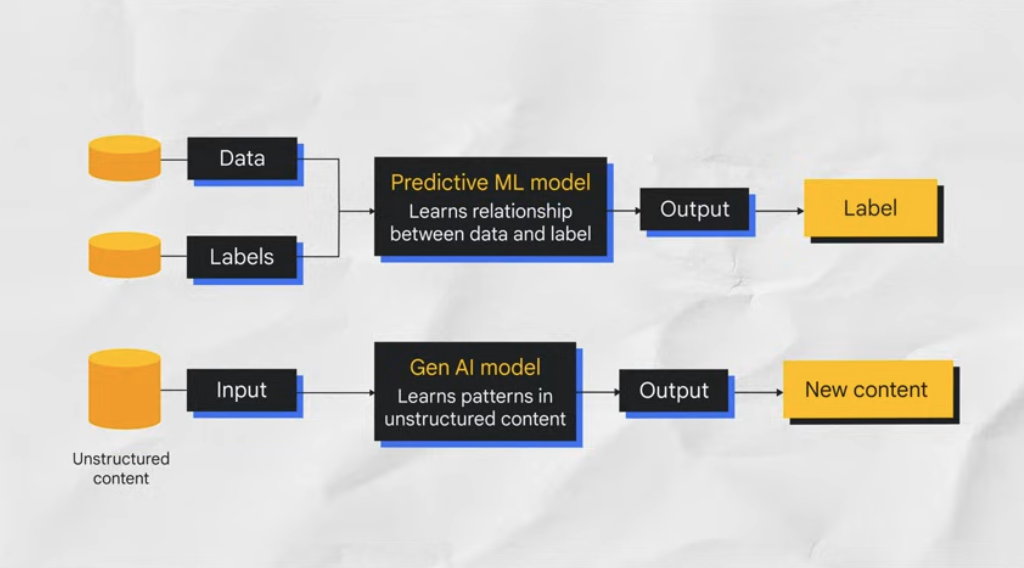
The simple explanation
Artificial intelligence is the broad category. It describes systems designed to do tasks that feel intelligent: understanding language, analyzing information, making recommendations, recognizing patterns, planning actions, or helping solve complex problems.
Machine learning is the data-learning layer inside many of those systems. It trains models on examples so they improve over time instead of relying only on hand-written rules. In practice, a lot of what people casually call AI is an ML model wrapped inside a larger product.
AI and ML in one view
This is the easiest way to explain the relationship without muddying the terms.
| Concept | What it means | Main goal | Typical output |
|---|---|---|---|
| Artificial intelligence | A broad set of technologies for building systems that can reason, learn, act, or adapt | Make machines useful on tasks that normally require human judgment | An intelligent system or product experience |
| Machine learning | A subset of AI that learns patterns from data | Improve predictions or decisions through training instead of only fixed rules | A trained model that gets better with more data |
The three AI capability levels people usually hear about
These labels describe scope, not product maturity.
- ANI, or artificial narrow intelligence, is the specialized form in use today: systems that do a bounded task well, such as image recognition, speech transcription, ranking, or recommendation.
- AGI, or artificial general intelligence, refers to a human-level system that could handle a wide range of intellectual tasks rather than one narrow job.
- ASI, or artificial super intelligence, is the theoretical idea of systems that exceed human capability across domains.
How the pieces fit together
The clean mental model is a stack. AI is the system-level goal. ML is a major learning method inside that goal. Deep learning is a more specific ML method, and other AI subfields include robotics, expert systems, natural language processing, search, planning, and decision systems.
That matters in modern products because the user rarely touches a model by itself. They touch a full AI workflow: data pipelines, policies, retrieval, model calls, interfaces, monitoring, and human review. ML powers many of those workflows, but it is not the whole product.
AI vs ML in practical terms
The difference becomes clear when you compare scope, data, and system behavior.
| Dimension | Artificial intelligence | Machine learning |
|---|---|---|
| Scope | Broad: covers systems that simulate intelligent behavior | Narrower: focuses on learning patterns from data |
| Goal | Solve complex tasks in a way that feels intelligent | Increase prediction or decision quality through training |
| How it works | Combines reasoning, logic, decision systems, models, and other techniques | Uses algorithms that learn from data and improve with exposure to more examples |
| Data footprint | Can span structured, semi-structured, and unstructured data | In business systems, often centers on structured or semi-structured training pipelines even when downstream apps handle richer inputs |
| What you build | An intelligent product or workflow | A predictive or adaptive model inside that product |
The commute example makes the relationship obvious
Imagine asking a smart assistant how long your commute will take. The AI product is the full experience that understands the request, decides what the user needs, and returns a useful answer in a natural way.
The ML piece is narrower. It might analyze traffic history, live road conditions, and travel patterns to forecast congestion. AI is the end-to-end intelligent experience; ML is one statistical engine helping that experience work.
Why companies use AI and ML together
The business value usually comes from the combination, not from treating them as separate departments.
- They help teams work across a wider range of structured and unstructured data.
- They speed up decision-making by processing data faster and reducing manual error.
- They improve operational efficiency and lower the cost of repetitive work.
- They push predictions and recommendations into everyday business tools instead of leaving analysis in a dashboard.
What modern AI and ML systems can do
The current stack is broader than classic prediction models alone.
| Capability | What the ML layer does | What the broader AI system does |
|---|---|---|
| Multimodal AI | Learns from text, images, audio, video, and code | Lets products search, analyze, and respond across multiple kinds of input |
| Reasoning and agentic workflows | Supplies trained models that can evaluate and rank next steps | Turns those model outputs into multi-step plans, actions, and orchestration |
| Hyper-personalization | Finds patterns in user behavior, demand, and preferences | Uses those patterns to tailor recommendations and optimize systems in real time |
| Diagnostic augmentation | Finds patterns in large image, sensor, or record datasets | Surfaces insights to experts who still make or guide the final decision |
Where AI and ML show up by industry
The applications are similar across sectors even when the data and stakes differ.
| Industry | Common uses |
|---|---|
| Healthcare and life sciences | Health-record analysis, outcome forecasting, drug discovery support, image-based diagnostics, monitoring, and information extraction from notes |
| Manufacturing | Machine monitoring, predictive maintenance, IoT analytics, and production optimization |
| Ecommerce and retail | Demand forecasting, inventory planning, visual search, recommendation engines, and personalized offers |
| Financial services | Risk analysis, fraud detection, automated trading support, and process optimization |
| Telecommunications | Network optimization, predictive maintenance, capacity forecasting, upgrade planning, and business process automation |
How to explain AI vs ML to a non-technical team
If the room is getting lost in vocabulary, use these lines.
- AI is the larger ambition: building systems that act intelligently.
- ML is a major method used inside AI systems to learn from data.
- Not every AI system is just an ML model, and not every ML model is a full AI product.
- The product a user touches is usually AI at the system level, while the predictive engine inside it is often ML.
Frequently asked questions
These are the questions teams usually mean when they ask for an AI vs ML explanation.
Is machine learning the same as artificial intelligence?
No. Machine learning is a subset of artificial intelligence. It is one major way AI systems learn from data, but AI is the broader category.
Can AI exist without machine learning?
Yes. Rule-based systems, logic systems, expert systems, and other approaches can still count as AI even without modern ML training.
Why do people mix up AI and ML so often?
Because many popular AI products rely heavily on machine learning, so the terms blur together in everyday conversation even though they refer to different layers.
Where does deep learning fit?
Deep learning sits under machine learning, which itself sits under AI. It is a more specific family of learning methods inside the larger stack.
What should a business team care about more: AI or ML?
Most teams should care about the business problem first. AI is the system-level lens. ML is the implementation layer that often powers prediction, adaptation, and ranking inside that system.
Reference shelf
A few practical references for explaining AI, ML, and the applied systems that sit around the model.
Primary explainer for the relationship between AI as a broad system category and ML as a learning method inside it.
Useful companion source for the broader AI systems framing and common business applications.
Adjacent reference on how modeling, data pipelines, evaluation, and product constraints turn machine learning into working software.